
Why AI Can Never Grasp Our Language-Games
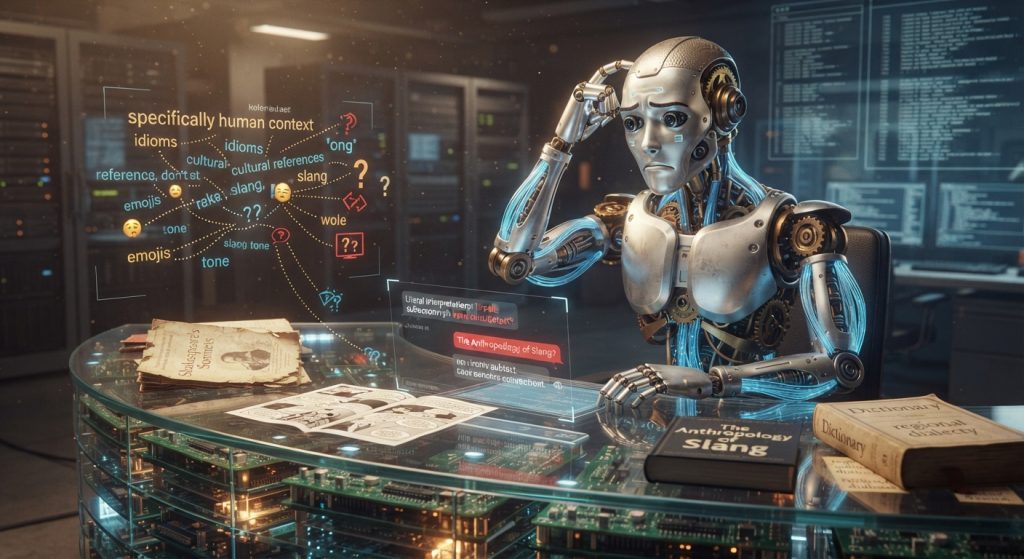
As Large Language Models (LLMs) or linguistic AIs continue to flood the internet with essays, emails, B2B writing and even fiction, a question arises: will these machines eventually replace human writers? Indeed, we are often told that the Natural Language Processing deployed by LLMs will soon erase the boundary between human and machine authorship. However, the unique nature of human language-games will forever prevent this happening.
Anyone who has read a great poem by Goethe or Shakespeare, or laughed at a witty line in Aeschylus or Voltaire knows there is a vast chasm between pattern recognition and true expression. AI can certainly mimic the structures of language, but it can never truly replicate the unique human voice.
To understand why, we have to turn to one of the 20th century’s greatest language philosophers: Ludwig Wittgenstein.
Wittgenstein and Language-Games
Long before computers could string a sentence together, Wittgenstein revolutionized how we think about meaning. His later philosophy argued that words do not have fixed, isolated definitions waiting in a dictionary. A word’s meaning depends on its use within a specific social, cultural and situational context. The philosopher classified these contexts as language-games.
In sum, word-meaning shifts depending on who is using it or why, and what unstated shared experiences lie behind that usage. A single word can carry irony, warmth or malice, depending on its associated usage-context.
LLMs Play a Rigged Game
Large Language Models do not understand language-games; they understand probabilities.
Natural Language Processing in AI works through massive statistical pattern recognition. When an LLM writes a sentence, it is calculating which word mathematically comes next based on algorithmic parameters. It can mimic the pattern of a joke or the structure of a sonnet, but cannot understand the contextual reality that gives those words weight.
- Humor and Wit: True hum our relies on subversion, shared cultural absurdity, and timing. All of these emerge spontaneously from a lived, embodied life. An AI does not find things funny because it has never been surprised, vulnerable, or alive. Its ‘jokes’ are merely pastiches of hum our compiled by probabilistic calculation.
- Warmth and Nuance: Warmth is an emotional state. It requires a sender and a receiver who both understand this element of existence. A machine cannot offer empathy because it has no skin, mortality or interior life. When an AI generates a comforting phrase, it is just simulating the emotion behind it.
- Subtle Nuance: Human nuance relies on infinite layers of unspoken context: family histories, local dialects, historical traumas and fleeting moods. By definition, these dynamics constantly break statistical rules. The writer must bend or shatter conventions to capture a precise emotional truth.
The Domain of the Machine
This is not to say LLMs are entirely useless. They are exceptionally powerful tools in some conceptual arenas: calculating sums, parsing code, finding patterns in vast datasets and generating formulaic summaries. In these realms of information and logic, they excel.
However, effective business and legal writing or gripping literature do not exist purely to transmit data. A novel or a poem is a report from the front lines of a human life. It carries the distinct fingerprint of an author who has suffered, rejoiced and considered the world through a unique, finite perspective.
The Unconquerable Voice
AI can harvest our vocabulary but cannot inherit our condition. Because it lacks a body and a lived history, it can never truly grasp or play Wittgenstein’s contextual language-games.
An LLM can write an essay about grief, but it has never wept. It can write a love poem, but it has never yearned. It can write a whiskey advert, but can never taste whiskey or appreciate its historical and cultural context.